Skip to content

Firsthand.today

#coding agents

  1. Software factories and code reviews with Harjot Gill

    newsletter.pragmaticengineer.com · Gergely Orosz

    CodeRabbit founder Harjot Gill describes running an agent-heavy software factory: 40 engineers shipping over 5,000 PRs a month at roughly $250K monthly AI spend, with verification layers from TLA+ to staged rollouts, and release-level review replacing per-PR review.

  2. How Airbnb uses cost per task to operate coding agents on Amazon Bedrock

    aws.amazon.com

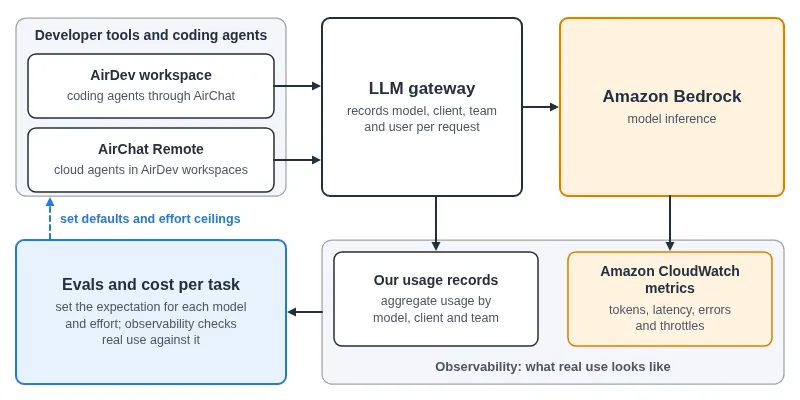
    Airbnb runs coding agents for thousands of engineers through an LLM gateway on Amazon Bedrock. It prices whole tasks from four token types, pairs eval scores with cost per task to set model defaults and effort ceilings, and uses CloudWatch metrics to catch production drift.

  3. Half of What AI Delivers Needs Rework: After Logging 204 Dispatches, Managing AI Is Managing a Team

    liuqiwei.dev · 刘启威

    Over three weeks and 204 dispatches to five coding agents, first-pass acceptance stayed near 50% (Codex 38%, Antigravity 51%, DeepSeek Harness 50%), yet final pass rates reached about 80% through independent cross-model acceptance, a two-round rework cap and written completion definitions. The biggest cost was the coordinator re-reading context, once 39 million cached tokens in a single task.

  4. AI agents that need constant babysitting are not really agents

    r/AI_Agents · Few-Garlic2725 · 49 comments

    Reviewing a 500-line agent diff can take longer than writing the change by hand; give the agent a narrow job with a check that needs no line-by-line reading (tests pass, diff stays small, no new dependencies), track total human minutes, and widen scope only where it keeps passing.

    — Ramdhan77
  5. How the Claude Code team thinks about verification

    claude.dev · Addy Osmani · 233 comments

    The verification workflow is token-expensive; a verify skill raised trust in AI coding but used much more time and spend, so simple changes still skip it and DeepSeek was adopted as the cheaper workhorse.

    — gregwebs
  6. What is the best harness for each model?

    Hacker News · Edward40 · 131 comments

    Cost per pass is largely explained by steps per pass, which is close to tautological since token spend tracks step count; steps are also not directly controlled by the harness the way tool set and system prompt are, and failed runs that spin for a long time inflate variance.

    — Majromax