一个固定价格项目让我白干了三周
The fixed-price project that cost me three weeks of unpaid work — MobileByteSensei
摘要
一个报价 £12,000、预计 6 周的 Kotlin Multiplatform 迁移实际做了 9.5 周,实际时薪降到每周 £1,263,算上推掉的一个项目,真实损失约 £15,000。三个原因中有两个在没拿到仓库和 CI 权限时根本看不到。
正文
太长不看版
我报价 £12,000 做一个为期六周的 KMP 迁移。结果做了九周半。我交付了,也拿到了 £12,000,但有三周半的工作是白干的——按我的日薪算大约 £7,000。
超期并不是因为我无能。三个原因里有两个,是我在报价时没有权限、根本不可能知道的:一个没有文档的原生依赖,以及一个只有客户才能给我看的 CI 系统。固定价格意味着我已经同意,无论这些东西最后是什么样,都由我来承担。
固定价格是一种风险转移,被转移的风险就是估算的不确定性。要么把它明确算进价格,要么改合同,让不确定性落在能解决它的人身上。
这篇文章要讲的案例
需求是:把一个 Android 应用的数据层和领域层迁移到 Kotlin Multiplatform,由 iOS 使用共享模块。我之前做过两次类似的迁移。
我的估算:
data layer (Room → SQLDelight)          2 weeks
domain + use cases                      1 week
networking (Retrofit → Ktor)            1.5 weeks
iOS integration + sample screen         1 week
buffer                                  0.5 weeks
                                       ───────────
                                         6 weeks  @ £2,000/week = £12,000
签的是固定价格、固定范围,预付 50%。我只看过仓库的 README 和一次应用演示的屏幕共享,没看过代码库。
症状
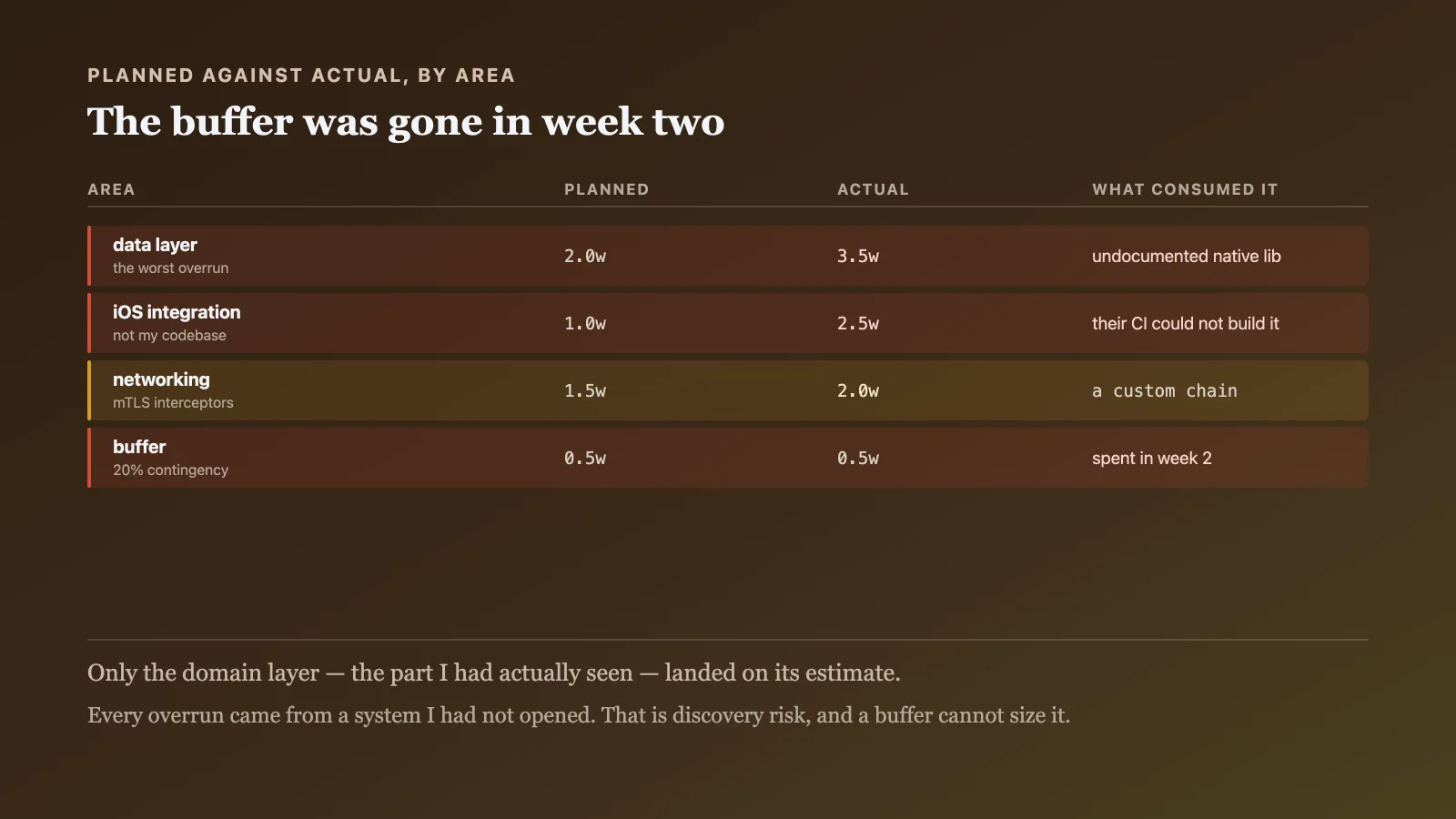
九周半:
planned                            actual    reason
data layer          2 weeks        3.5 weeks  an undocumented native library in the DAO path
domain              1 week         1 week
networking          1.5 weeks      2 weeks    a custom OkHttp interceptor chain for mTLS
iOS integration     1 week         2.5 weeks  their CI could not build a framework; I built it
buffer              0.5 weeks      0.5 weeks  consumed in week 2
                                   ─────────
                                   9.5 weeks
三个原因,以及我本能否知道:
cause                                  knowable at quoting time?
an undocumented JNI library used by
  four DAOs, no source available        NO  — needed repository access
a custom mTLS interceptor chain         PARTLY — I could have asked "any custom
                                        networking?" and did not
their CI could not produce an iOS
  framework; no Mac runners existed     NO  — needed CI access
三个原因里有一个是我没问。另外两个需要我没有、也没有去申请的权限。
财务结果:
quoted                        £12,000
weeks worked                      9.5
effective rate              £1,263/week   (vs my £2,000 target)
unpaid, at my day rate         ~£7,000
还有二阶成本: 第 7 周我推掉了一个为期四周的项目,因为我还在做这个。那又是 £8,000 的机会成本,所以估算失误的真实代价接近 £15,000,而不是 £7,000。
为什么显而易见的办法不管用
“估算得更好一点。” 三个原因里有两个,没有权限就是看不见。再好的估算技巧也解决不了我没有的信息——而唯一一个我靠提问就能发现的原因,恰恰是“估算得更好”唯一适用的部分。
“多留点缓冲。” 我留了 0.5 周,第 2 周就用完了。就算我报 9 周,大概也拿不到这单——客户手上还有另外两个报价,分别是 6 周和 7 周。缓冲大到足以覆盖真正的未知,就会把你挤出局,这才是真正的困局。
“超期了就发起变更单。” 我的合同里没有变更单条款。“固定价格、固定范围”,又没有机制去发现范围本身描述错了,意味着我只有两个选择:自己扛下来,或者停工,而停工就会让我丢掉这个推荐。
“报价前先要仓库权限。” 这是正确答案,我没做,因为开口要权限让我觉得会给一桩我想拿下的交易添摩擦。这种不情愿才是值得点名的东西:开口的代价是社交上的不适,不开口的代价是 £15,000。
真正的机制
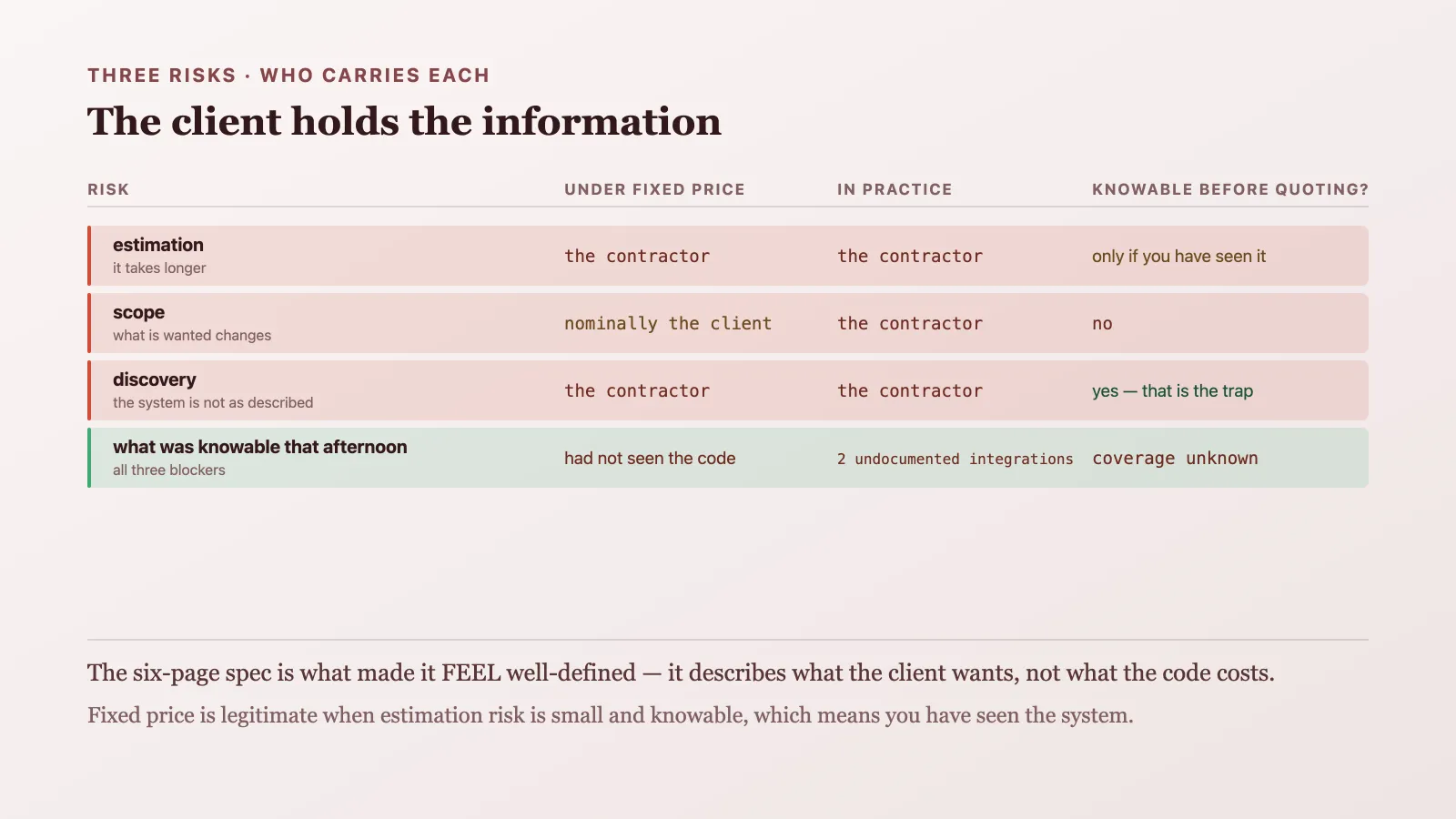
合同形态决定谁承担哪种风险,而这类项目里有三种风险:
估算风险——工作比预期花的时间更长。固定价格把它完全压在承包方身上。
范围风险——想要的东西变了。固定范围名义上把它压在客户身上,实际上压在承包方身上,因为“这本来就是隐含的”这种争论你赢不了。
探索风险——系统跟描述的不一样。这一条才是陷阱:信息在客户手里,后果由承包方承担。
当估算风险小且可知时,固定价格是一种合理的形式,也就是说,你见过那个系统。如果你没见过,固定价格就是在拿你不掌握的信息下注,而客户甚至不知道你在下这个注。
这样一来,合同形式就成了一个可以推导出来的答案,而不是谈判时的直觉——报价之前,所有输入都是已知的:
def contract_shape(*, seen_the_code, test_coverage_known, integrations,
                   undocumented_integrations, spec_pages, prior_projects_with_client):
    blockers = []

    # Discovery risk is the trap: the client holds the information, the contractor
    # holds the consequence. Not having seen the system is disqualifying on its own.
    if not seen_the_code:
        blockers.append("have not seen the codebase")
    if undocumented_integrations > 0:
        blockers.append(f"{undocumented_integrations} integration(s) with no documentation")
    if not test_coverage_known:
        blockers.append("unknown test coverage — no signal on regression cost")

    if blockers:
        return ("time-and-materials", blockers,
                "Or: a paid discovery phase, fixed price, 2-3 days, deliverable is the estimate.")

    # Even with full information, a long project accumulates scope risk that no amount
    # of estimation skill addresses. Cap the fixed-price window rather than the price.
    if spec_pages > 20 or integrations > 3:
        return ("fixed-price per milestone", [],
                "Whole-project fixed price over this size is estimation skill vs. compounding scope.")

    if prior_projects_with_client == 0:
        return ("fixed-price, 50% deposit", [], "No history: the deposit is the scope-change brake.")

    return ("fixed-price", [], "")
说说那个具体的案例——那份让我白干了三周的报价:
>>> contract_shape(seen_the_code=False, test_coverage_known=False,
...                integrations=4, undocumented_integrations=2,
...                spec_pages=6, prior_projects_with_client=0)

('time-and-materials',
 ['have not seen the codebase',
  '2 integration(s) with no documentation',
  'unknown test coverage — no signal on regression cost'],
 'Or: a paid discovery phase, fixed price, 2-3 days, deliverable is the estimate.')
三个阻碍,每一个在报价发出去的那个下午都是可知的。那份六页的规格说明恰恰让它显得定义清晰——而 spec_pages 是故意留到探索检查之后才看的,因为详细的规格说明描述的是客户想要什么,而不是你从未打开过的系统会让你付出什么代价。
I have seen the codebase, done this exact migration twice  →  fixed price is reasonable
I have seen a README and a screen-share                    →  fixed price is a wager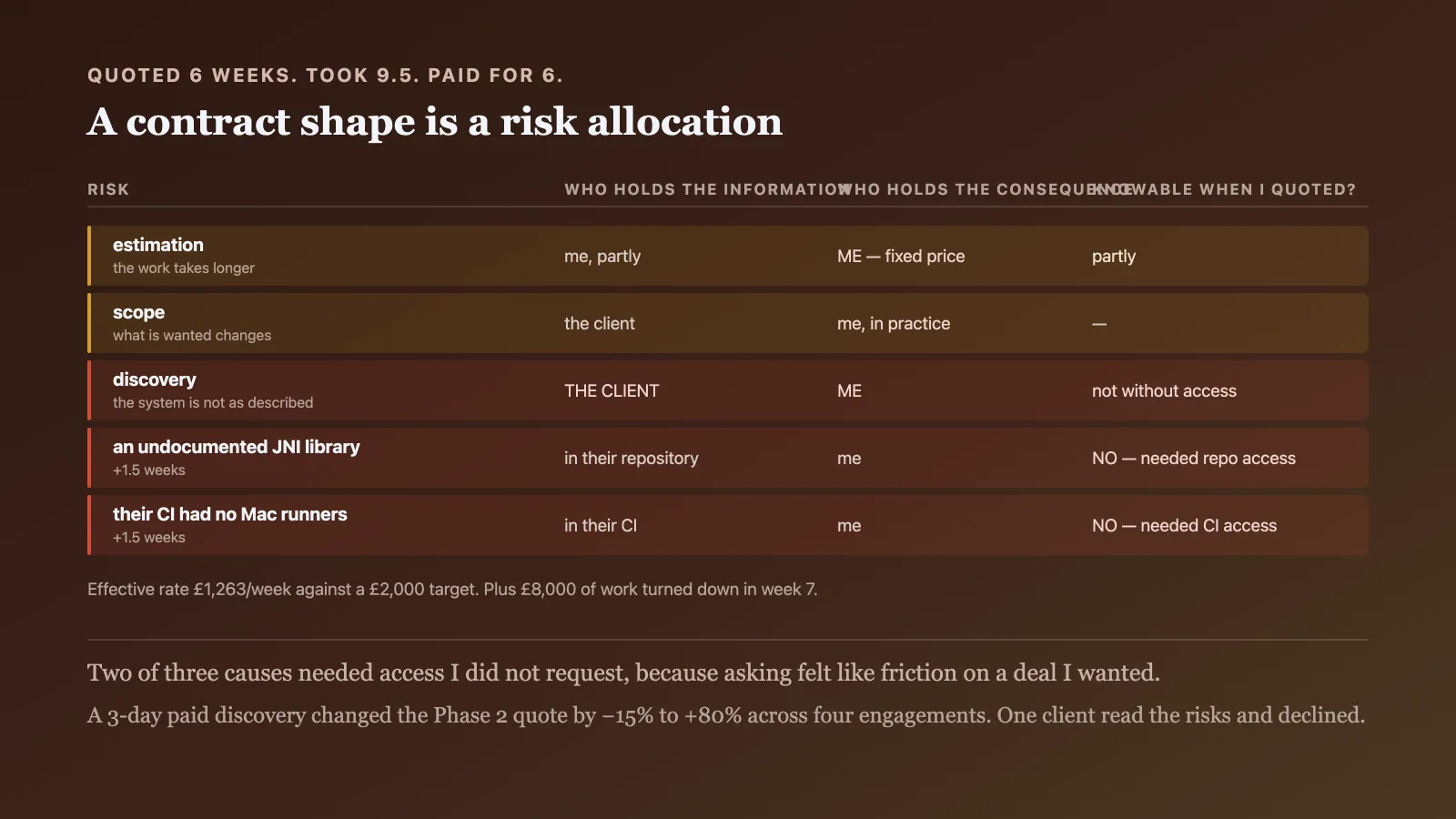
固定价格把估算风险和探索风险转移给了你。当你掌握给它们定价所需的信息时,这没问题;而当客户手里有你没问过的信息时,这就是一场赌博。
解决办法
三处改动。此后这三个我都用过,其中第一个起了大部分作用。
1\. 付费探索阶段,这就是全部的解决办法:
## Phase 1 — Discovery (fixed price, 3 days, £1,800 — £600/day)

Deliverables:
  - a written migration plan with a module-by-module breakdown
  - a list of risks found, each with an impact estimate in days
  - a fixed-price quote for Phase 2, valid for 30 days

Access required: read access to the repository, a CI run log, and 90 minutes
with an engineer who knows the networking layer.

If you choose not to proceed to Phase 2, the plan is yours.
注意这个费率:每天 £600,而我交付阶段收每天 £400。这是故意的,我在提案里也明说了——探索是整个项目里杠杆最高的部分,是客户可以拿去别处做的那部分,而按交付费率给它定价让我学到:客户会把便宜的计划读成免费的计划。三个付费日换来的是让我能给出诚实固定价格的信息,也给客户换来一份无论如何都归他们的计划。此后四个项目里,探索让我在报价前的直觉基础上调整了第二阶段报价:+80%(下面的项目 C)、+11%、−15%,还有一个项目因此变成了拒绝接单——这就是不确定性变得可见,而不是被吸收掉。−15% 和 +80% 一样重要:探索不是用来报高价的工具,而一个见过它把报价调低过一次的客户,会愿意再为它付钱。
2\. 变更单条款,让项目中途的探索有路可走:
## Changes
Work outside the Scope section, or work required by a condition of the system
not described in the Discovery report, is a Change Order: a written estimate
in days, signed by both parties before the work begins, billed at £400/day.

Either party may decline a Change Order. Declining pauses only the affected
deliverable.
“系统存在探索报告未描述的情况”这句话,本来就能覆盖那个 JNI 库和缺失的 Mac runner。
3\. 在无法探索的地方,换一种形式:
## Option B — Time and materials with a cap
£400/day, invoiced fortnightly, capped at 30 days without a signed extension.
Weekly written progress with days-used and days-remaining.
上限让客户能接受 T&M——他们怕的是无上限的账单——它限定了客户的敞口,同时把估算风险留给了同样控制不了它的那一方。
我现在报任何固定价格之前都会问的问题:
- May I have read access to the repository for two hours?
- Does CI currently build and test every target you need? Can I see a recent run?
- Any native code, JNI, custom networking, or vendor SDKs in the affected layers?
- Who decides "done", and have they written down what that means?
- What has been tried before and why did it stop?
五个问题,大约十分钟。光第三个问题就能找出我三个原因里的两个。
后来怎么样了
此后四个带探索的项目:
project   discovery  Phase 2 quote   actual    variance
A           £1,800      £14,000      £14,000      0%
B           £1,800      £21,600      £23,200     +7%   (one change order, signed)
C           £1,800       £9,000       £9,000      0%   (quote was 80% above my
                                                       pre-discovery instinct)
D           £1,800           —          —        client declined Phase 2 after
                                                 reading the risk list
项目 C 最能说明为什么需要做需求调研:在看到代码之前,我凭直觉估的是 5000 英镑左右,而代码里藏着一个会让工期多出四周的问题。要是凭直觉报价,几乎等于把当初的错误原样再犯一遍。
项目 D 则是另一半:客户看完风险后决定不做。我拿到了调研费,他们避开了一个注定会超期的项目,双方都没损失。一次调研能得出“不做”的结论,就说明它起作用了。
再说实际时薪:
                     effective weekly rate
the fixed-price job           £1,263
A                             £2,000
B                             £1,940
C                             £2,000
有一个我不得不承认的限制:付费调研在销售沟通里多了一道环节,我也因此丢过活——两次,输给了上来就报固定价的承包商。那些项目他们做得怎么样,我不知道。我只知道,这三天的调研,决定了报价是靠信息还是靠祈祷,而我不愿意为了拿下一单,退回到靠祈祷那一边。
这件事能推广到什么程度
合同形式本质上是一种风险分配,值得说清楚分的是哪种风险。 固定价、按工时计费、预付金、按里程碑、按价值分成。没有哪种形式普遍正确;每种只是把估算风险、范围风险和调研风险放在了不同的位置。
不要接下你无法定价的风险。 如果估算所需的信息握在对方手里,要么把信息拿到,要么拒绝这种合同形式。闷头把风险吞下去,等于在客户不知情的情况下拿自己赌一把。
为那些让估算变得靠谱的工作收费。 调研是实打实的工作,有实打实的交付物。免费送掉它,最后就只能照着 README 报价——而只要把调研包装成一份方案,客户是很乐意付钱的。
开口问的那点不自在,比超期的代价便宜多了。 因为不好意思要仓库访问权限,我损失了大约 15000 英镑。报价前先问一份十分钟就能列完的问题清单,是我养成的最划算的习惯。
- 范围蔓延是合同问题,不是沟通问题——变更单条款的实际运用
- 那个我总也说不对的报价对话——反过来定价
- 估算是分布,而你只报了众数——本文的估算那一半
继续阅读
本文是 面向工程师的自由职业与咨询 系列的一部分——写的是这份工作商业的一面,来自踩过的坑。关注 MobileByteSensei 看后续内容。
本文为中文翻译,版权归原作者所有,内容以原文为准。
这篇对你有用吗?